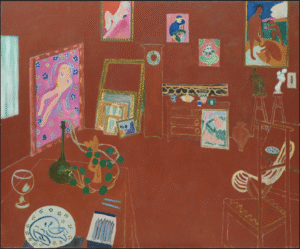
The Red Studio, 1911
Oil on canvas
Museum of Modern Art, New York
Painted at a moment when Matisse was radically rethinking how color could structure space, The Red Studio transforms a familiar setting into something entirely new. Rather than depicting his studio realistically, Matisse floods the entire interior with a deep red that absorbs walls, floor, furniture, and artworks alike. Objects are reduced to outlines, losing their physical weight and material texture. The result is a space organized not by perspective but by color. Depth collapses, and the studio becomes a unified visual field. Instead of inviting the viewer into a believable room, Matisse asks them to experience the space emotionally. Color here does not describe the world. It reshapes it, turning the studio into an expressive environment rather than a functional workspace.
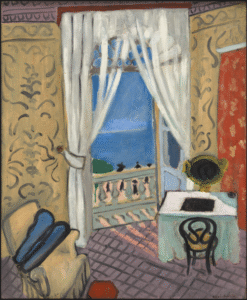
Interior with a Violin Case, 1918-19
Oil on canvas
Museum of Modern Art, New York
Matisse presents a domestic space stripped of realistic depth and spatial logic. Furniture and architectural elements appear flattened, arranged within broad areas of color rather than positioned in a convincing perspective. The violin case, an object associated with sound and rhythm, becomes part of the overall visual harmony rather than a focal point. Color plays a central role in organizing the composition. Surfaces that should recede or project instead exist on a single plane, encouraging the viewer to read the room as an emotional arrangement rather than a physical space. This interior feels intimate yet abstract, suggesting that Matisse was less interested in documenting domestic life than in exploring how color could shape mood and perception within enclosed spaces.
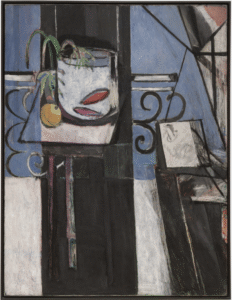
Goldfish and Palette, 1914-15
Oil on canvas
Museum of Modern Art, New York
Goldfish appear frequently in Matisse’s work, often symbolizing calm and contemplation. In Goldfish and Palette, the interior setting becomes a quiet stage where color relationships guide the viewer’s attention. The fishbowl, palette, and surrounding objects do not behave according to strict spatial logic. Instead, they are unified through color and surface pattern. The interior feels deliberately composed, with color linking objects that would otherwise occupy different depths. Matisse invites the viewer to linger rather than move through the space. This painting suggests that interiors can function as emotional retreats, where color creates a sense of balance and stillness. Rather than depicting a moment of everyday life, Matisse uses the interior to cultivate a reflective visual experience.
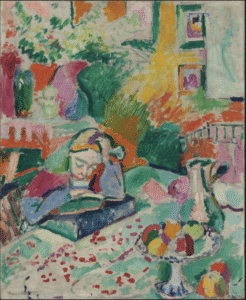
Interior with a Young Girl, 1905-06
Oil on canvas
Museum of Modern Art, New York
This quiet interior scene centers on a young girl placed within a carefully ordered field of color. The room is not rendered as a realistic environment but as a flattened arrangement of planes that guide the viewer’s gaze. Furniture, walls, and floor merge into a cohesive composition shaped by color rather than depth. The girl’s presence adds a human stillness to the space, yet she does not anchor the room in narrative or action. Instead, she becomes part of the overall harmony. Matisse uses the interior to explore the emotional atmosphere rather than storytelling. The result is a space that feels contemplative and enclosed, where color shapes both the physical environment and the mood it conveys.
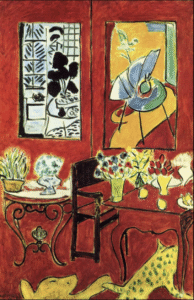
Large Red Interior, 1948
Oil on canvas
Museum of Modern Art, New York
Matisse returns to the bold use of red to organize an entire space. The interior is saturated with color, flattening architectural boundaries and dissolving distinctions between wall, floor, and furniture. Decorative patterns and repeated motifs further blur spatial divisions. Rather than offering a sense of depth or realism, the painting presents the room as a unified surface. Color functions as both structure and expression, shaping how the viewer experiences the space emotionally. This interior does not invite physical entry. Instead, it encourages visual immersion. The room becomes a world defined by rhythm, balance, and chromatic intensity rather than by conventional perspective.
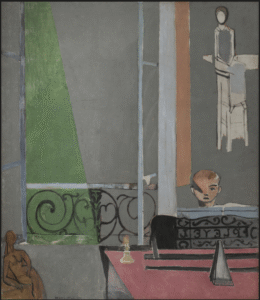
The Piano Lesson, 1916
Oil on canvas
Museum of Modern Art, New York
The Piano Lesson presents an interior marked by restraint and tension. Unlike Matisse’s more vibrant interiors, this painting relies on muted tones and carefully controlled geometry. The room is structured through large areas of color and simplified forms, creating a sense of quiet concentration.The figures and objects appear still, almost suspended, reinforcing the painting’s contemplative mood. Color does not overwhelm the space but subtly directs attention and emotional response. Here, Matisse demonstrates that color can shape the atmosphere even when used sparingly. The interior becomes a psychological space, where discipline, silence, and structure are communicated visually rather than through narrative detail.
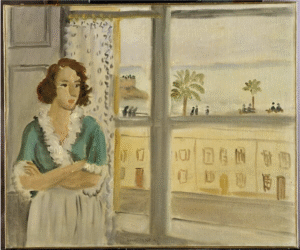
Girl by a Window, 1921
Oil on canvas
The Metropolitan Museum of Art, New York
Matisse explores the boundary between interior and exterior space. The window does not function as a transparent opening onto the outside world. Instead, it becomes a compositional element that connects interior surfaces through color and pattern. The girl stands within a space that feels enclosed and emotionally charged. Color links the room and the view beyond the window, flattening depth and keeping the viewer’s attention anchored inside. Rather than offering escape, the window reinforces the interior as a self-contained environment. Matisse uses color to mediate perception, shaping how the space is experienced rather than how it is realistically seen.
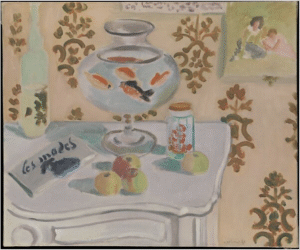
The Goldfish Bowl, 1921-22
Oil on canvas
The Metropolitan Museum of Art, New York
In this interior scene, Matisse again places the goldfish bowl at the center of a carefully constructed environment. The bowl acts as a visual anchor, while surrounding patterns and colors flatten the space around it. Furniture, window, and decorative elements are unified through shared color relationships. The interior feels calm and self-contained. Depth is suggested but never fully developed, encouraging the viewer to focus on surface and rhythm. Matisse transforms the room into a meditative space, where color organizes attention and emotion. The goldfish, suspended within their bowl, mirror the viewer’s own position within the painted interior.
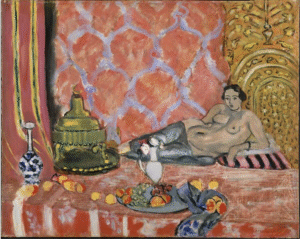
Odalisque with Gray Trousers, 1927
Oil on canvas
The Metropolitan Museum of Art, New York
In Odalisque with Gray Trousers, Matisse combines the interior setting with the reclining figure, dissolving the boundary between body and space. Patterned fabrics, furniture, and walls surround the figure, creating a richly decorative environment where color dominates form. The interior is not meant to feel realistic. Instead, it operates as an expressive backdrop that enhances mood and sensuality. Color links the figure to her surroundings, flattening space and emphasizing surface. Through this interior, Matisse demonstrates how color can unify figure and environment, transforming the room into an emotional and visual extension of the body itself.
All paintings above were created by Henri Matisse.

